
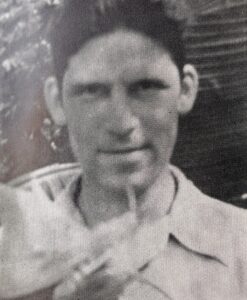
I met Joe Moreno in 1975 when he visited BBTI. I was a missionary student preparing to do what Joe had done for nearly thirty-five years, reach the most unreached people groups. For him this meant finding and making friendly contact with the Ayorés, a savage Bolivian Indian tribe. We students stayed up almost all-night listening to Joe’s stories and asking questions. We did not fully realize we were in the presence of a truly great man. However, Joe would not call himself a missionary, probably because he had only a sixth-grade education and perhaps due to his material status. His wife had left him and his three young children.
Joe was born in Texas, and Spanish was probably his first language. By day he was a mechanic and by night a carouser. At twenty-four years old, he moved to Mount Pleasant, Michigan, where his life of debauchery would continue for six more years.
A group of mission-minded men and women in the Mount Pleasant area had learned of the helpless condition of the Ayoré Indians and were making plans to reach them. The leader of the group, Cecil Dye, was pastoring a church in Mt. Pleasant and had also begun a youth club with a strong emphasis on missions. Joe heard Cecil preach the Gospel and was gloriously saved. His life was instantly transformed, and he began witnessing to everyone. When he heard of Cecil’s mission plans, Joe said, “I can carry a missionary’s suitcase. I can go and be Cecil’s flunky! ” Read the exciting story in the book, God Planted Five Seeds, by Jean Dye Johnson, published by Ethnos360.
In November 1942, this newly formed group (that became known as New Tribes Mission) was founded by Paul Fleming and Cecil Dye and moved to Bolivia. The group consisted of Cecil and Dorothy Dye, Bob and Jean Dye, Dave and Audry Bacon, George Hosbach, Eldon Hunter, and Joe Moreno. Joe’s children, as was the practice of the group, were placed in a mission boarding school. Joe’s knowledge of Spanish was a great help to the group, and he also began reaching out to the Spanish-speaking people.
In June 1943, after much prayer, planning, and preparation, Cecil, Bob, Dave, George, and Eldon took to the jungle trails, seeking to make friendly contact with the Ayorés. The Ayorés had killed numerous so-called civilized ones, and civilized ones had killed many Indians and enslaved their children. The army and the railroad company wanted the Indians tamed or killed—it probably did not matter which—so they were in favor of the missionaries’ efforts. The group walked over thirty miles of mountains and cut through one hundred miles of dense jungle looking for Indian trails and footprints. When they found Ayoré campsites, they left gifts. Eventually the Indians left gifts for the missionaries. It is believed they made contact on November 19, 1943. They were never heard from again. Their wives and others hoped that they had only been taken captive, not killed, but it would be another five years before reliable testimony from the Indians who killed them eliminated all doubt. Their bodies were never found, but a few durable personal items proved the native’s account.
Joe was evangelizing Spanish-speaking villages and did not accompany the five men. After the group’s disappearance was obvious, Joe became the leader of the mission and dedicated himself to two things: finding the men if they were alive and making friendly contact with the Indians. Thus, Joe undertook the forward thrust of the mission. He would leave the base camp for weeks and sometimes walk hundreds of miles looking for Ayoré trails and campsites. Friendly contact was finally made after five years.
As we talked with Joe that night in 1975, he told of the Ayoré practice of burying alive an old person who could no longer keep up with the nomadic tribe. He tried to stop this, even by getting into the hole with the person. They either pulled him out or began throwing dirt on him.
My family moved to Oaxaca, Mexico, in 1979 and began working with an Indian group. People there asked me if I knew Tomás Moreno. They described him as an old man who traveled in the mountains telling people about Jesus. I said that I did not know him. Only recently I learned that Joe’s name was Ab Tomás Moreno. He died in El Paso in 1987. For someone unqualified to be a missionary, he did a great missionary work!
Fall 2025