There was no headstone for Charlotte Rowe until her name was uncovered among the missionaries appointed by American Baptist International Ministries during research as it prepared for its 200th anniversary.

Charlotte White Rowe was the first woman missionary to be officially appointed from the United States by any denomination or agency. Charlotte was born in 1782. Her early life was marked by sadness. She was orphaned at age twelve and widowed at twenty-two. She moved to Massachusetts where she was saved and joined First Baptist Church of Merrimac.

In 1813 Charlotte moved to Philadelphia and joined the Sanson Street Baptist Church. There she met and joined Charles and Phoebe Hough who were going to Burma to help Adoniram Judson with printing work. She applied to the Baptist Board of Foreign Missions in the summer of 1814. After much discussion, the majority consented to her approval but then said they did not have the funding to send her. She pledged her own small estate to the work and left for India. The next year, the mission society’s new ruling forbade the appointment of single women missionaries.

After four months at sea, Charlotte and the Houghs landed in Calcutta and traveled to Serampore. It took two months for them to arrange shipping for the printing press and supplies to Burma. During that time, she met missionary Joshua Rowe, a widower with three small boys. They were married and Charlotte stayed in India with her new family while the Howes went on to Burma.

Charlotte’s first task was to learn the local language, Hindi. She was a remarkable linguist and learned so quickly that she soon began establishing schools. It wasn’t hard to get native teachers for the boys. To get teachers for the girls she had to hold classes and train the women first. Her resources were limited so she began writing schoolbooks in Hindi.

After only seven years of marriage, with six children and a busy and thriving ministry, Joshua Rowe died. Charlotte was only financially able to continue for an additional three years. She traveled to London in hope of being appointed by the British Mission society, only to find that they, too, had established a ruling against single women missionaries. She then worked to raise passage back to the United States where she ran a boarding school with the help of her twin daughters until the girls died, one in 1851 and the other in 1852. Charlotte died in 1863 at the age of eighty-two and was buried beside her twin daughters in an unmarked grave.

“I am but a mere instrument in God’s hand . . .” —Charlotte Rowe

Summer 2022

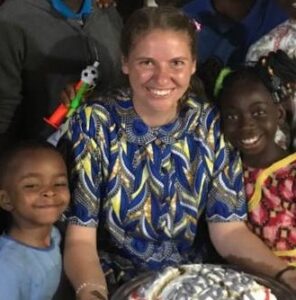
Joe and Lindsay Risinger are 2019 BBTI graduates. Their children are Joseph (6), Abbie (4), and Titus (1).

It was August of 2019 when we began living in a village in northern Uganda where we could not understand a single word of our neighbors’ heart language. The language they spoke during their growing up years is the same language they use to ponder deep thoughts, and it was nothing but meaningless noise to our foreign ears. This local, tribal language called Lugbara was one that we were warned would not be an option for a foreigner to grasp. No language school exists [although Lugbara is spoken by 1.7 million people]. Because it is tonal, the most subtle change in one’s tone profoundly alters the expressed meaning.
God called us to these people, therefore we felt it prudent to take whatever steps necessary to understand their culture and communicate in their heart language. For months we would go out every single day, notebook in hand, and use the language acquisition tools we were given at BBTI. Under the shade of a mango or avocado tree while our three-year-old and one-year-old played on a papyrus mat with the African children, we carefully transcribed words and phrases to commit to memory afterwards.

What was their reaction? Absolute fascination! They could not fathom why this family would come from America to learn their language and do life with them. They were overwhelmingly humbled by our desire and anxiously supported our effort. The most frequent question was “Why? Why are you here? Why are you learning our language?” I explained, “Our plan is first, to learn the language, and second, to help people understand the truth of God’s Word.”

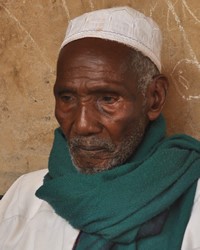
There is a mosque in our village which half of our local community attends. The Imam (leader) of the mosque is a man named Agobi. The only language he speaks is Lugbara. I met Agobi during our early months on the field but had very little ability to communicate with him. The Lord gave me a burning desire to share the Gospel with him. Our surface relationship was maintained for some time until two years later when he invited me to his home for tea. My heart was full as I was able to sit in his home and share, in Lugbara, the simple, powerful truths of who Jesus truly is. We pray he will one day turn to Christ.

The preaching of the cross and the hope we have in Christ is well worth any amount of language learning effort if it causes a single lost man to become more tender to such a message. By striving to speak the language of these people, a powerful statement of sincerity resonates in their hearts and minds. Every Lugbara person we encounter is met with an immediate connection and highly effective bridge to the Gospel because of the ability to speak their heart language. I cannot think of a better way to invest our time during these first few years on the field than learning this language.

Summer 2022

Photo Source: Jialiang Gao – Wikimedia Licensed under CC BY-SA 2.5

Among the mountains and valleys of the Shan state of Myanmar live the Golden Palaung. Over 200,000 Golden Palaung speak the Shwe dialect of Palaung, which comes from the Mon-Khmer language family.

The Palaung are able to grow a number of crops in their area and they trade for additional foods with their pickled tea (also called laphet). This exclusive novelty is made by fermenting tea leaves over a long period of time and then preparing them to be eaten as a salad.

In addition to their special pickled tea, their traditional houses are quite distinct, and very impressive. They are raised off the ground and can house as many as six families. Some houses are nearly one hundred feet long! In spite of all this room, there is little if any division for each family in the house. Consequently, it is not surprising that single family dwellings are now becoming the norm.

Most Golden Palaung practice Theravada Buddhism. In addition, they continue to practice their traditional animistic religion. A distinction in their animistic belief is that of “nat worship.” Nats are the spirits of inanimate objects. If the people experience hardship, they believe it is because the nats need to be appeased by offering items such as betel or tobacco. Offerings are also given by a shaman at ceremonies during marriages, births, and deaths.

Summer 2022

Billions of people in the world are bilingual and even multilingual. It is not unusual for people in India or Africa to speak four or five languages. Why should it be so difficult for missionaries to learn a new language or two? Perhaps we are going at language learning in the wrong way. The normal procedure for our missionaries is Bible college, deputation, and then a language school on their chosen field. There is a vitally important step that is usually overlooked: pre-field linguistic training such as has been available for Baptist missionaries at BBTI for nearly fifty years. Some have greatly benefited from it, however, the vast majority have either not known of its existence or chosen not to take advantage of it.

The language school method of language learning presupposes that a school is available for the language the missionary needs to learn. Language schools teach trade languages such as French, Portuguese, Spanish, Swahili, Arabic, Russian, Chinese, Japanese, Korean, etc. There are 7,151 languages in the world, and it would be safe to say that 6,000 or more of them have no language schools. Yet there are billions of lost souls that speak these languages: souls for whom Jesus died, souls that He desires to save, and souls that deserve to hear the message in their heart languages. Some of these languages have only a few hundred speakers while others have several million. With few exceptions, our Independent Baptist missionaries are not attempting to reach people whose languages have no schools because of the seemingly impossible language barrier. Many of these languages are still unwritten which of course means they have no portion of God’s Word. An estimated eighty-five percent of our missionaries go to only fifteen countries and then only to the major trade languages. Most of these countries have several other language groups. For instance, in the African country of Côte d’Ivoire, there are 77 languages besides the official French. Would you not agree that all people deserve to hear the Gospel in the language they understand best, just as we did?

A language school where one is available is a good idea but not when the missionary first arrives on the field. We suggest that he begins vigorously learning the language from the people and progress to a point of fluency in a more natural way. Schools are not the natural way to learn languages. We did not learn our first language in one! The method of language learning that we suggest may sound radical to Americans, but it works, and it is usually better and faster. This plan will require extreme dedication and diligence on the part of the missionary. If he is too undisciplined or unwilling to take on this responsibility and become a learner, leaving behind the mentality of a student, then he should simply go the language school route and live with its results and limitations.

We are not suggesting that the missionary simply go out with the people and “pick up the language” the best he can. No, we are suggesting a plan that involves a tried and proven method. The missionary can go to the field with this method and begin using it upon arrival. But he must learn the method here first. Before you ask, the answer is no; he cannot learn it on the internet. And it will take time. (Missionaries spend the necessary time to prepare theologically in Bible college and financially on deputation. Why should they not spend the necessary time to prepare linguistically?)

This natural language learning method is part of the overall nine-month Advanced Missionary Training (AMT) program of BBTI which provides many language and culture learning tools that are not available in Bible colleges. The first skill we teach is phonetics. I have said it a thousand times; one more time will not hurt: No missionary should attempt to learn a new language without first studying phonetics! (At BBTI both husband and wife take the same classes.) Students spend at least one hundred fifty literal classroom hours learning to recognize and reproduce any sound they may encounter (there are about eight hundred of them). Because he learns to produce the new sounds exactly as the native speaker, he can speak a new language with little or no foreign accent. An accent does not disappear with time; from the beginning, he must keep from superimposing his English habits on the new language by forming new habits that will last for life.

The missionary student uses his newly acquired phonetic skill for a following course, Situational Language Learning. This includes using a language helper (I did not say a language teacher) who speaks a foreign language well. (In recent years, we have used Sina-Sina from Papua New Guinea, Japanese, Korean, Khmer from Cambodia, and Spanish.) The student learns how to elicit the language from the helper in a step-by-step process, beginning with simple object-like words and slowly increasing the length of the utterances. In a short time, he is fluent in all the sounds of that language. In a few weeks, he, along with a partner, will progress to eliciting and learning dialogues natural to the native culture such as buying food in the market. If his target language has no language school, he can continue using this method for as long as needed. If a language school is available, he can enter it after a few months and advance rapidly in grammar and more vocabulary. He begins at the top of the class because he is not struggling with pronunciation. He will sound like a native. Speaking and acting like a native should make him much less of an outsider. He will be comfortable with the people and hopefully they will be more willing to listen to his message. They may even tell him, “You eat our food, you spend time with us, you talk like us. Hey, you are one of us!”

Jessi Pontius

Growing up in a Christian home, it was easy for me to realize as a child that I needed to trust Christ with my eternity. Trusting Christ with my life, on the other hand, was not so easy.

God first dealt with me about surrendering my life to Him when I was eleven or twelve years old. I had been reading my Bible (a habit I was still trying to start) when I came across Isaiah 6:8, “Also I heard the voice of the Lord, saying, Whom shall I send, and who will go for us? Then said I, Here am I; send me.” I had never heard God speak to me from His Word in such a way, and I really did not understand what the verse meant. I knew it was very important, but I did not see how. I had a slight feeling that this was God calling me to the mission field, but I denied it and moved on.

As I grew older, I realized what God was saying through that verse. Still, I denied it, convincing myself that God had not called me to the mission field.

Around the age of sixteen, I decided I was going to go into the Lord’s service—as a paleontologist. I wanted to show through fossils that God was Creator. Although a very nice plan, it was not God’s plan for my life. God brought this squarely to my mind through the passing of a loved one a year or so later. I had never felt the reality of death quite so strongly until that time. It made me wonder about the eternity of those who have never heard the Gospel. God showed me through that trial that although Creation ministry is good, His plan for my life was to be a missionary. I was finally ready to say what I had read a number of years before: “Here am I, send me!”

God first led me to Massillon Baptist College and has now placed me at Baptist Bible Translators Institute to prepare me for the mission field. Ever since I surrendered my life fully to God, He has only strengthened the desire in my heart to share His love with those who have not yet heard. Where God will finally lead me, I do not know, but I am so excited to see His plan unfold. All I can say is, “Here am I! Please send me!”

Spring 2022

Elisabeth on her last birthday

Tom and Barbara Needham were farmers, and they went to Cameroon, Africa, to teach the people better farming methods. There a missionary led them to Christ. They returned to Iowa, sold the farm, went back to Cameroon as missionaries in 1991. Their daughter Elizabeth, the fifth of seven children was two years old at the time. There she grew up and served the Lord with her family. She learned Pidgin English and Fulfulde, the language of the Fulani Muslim people, as well as sign language. Elizabeth was homeschooled and was saved at age six. At age twelve at summer camp, she was memorizing the words to the hymn their group was about to sing. “All to Jesus I surrender. All to him I freely give.” She realized that it was not true of her, but she immediately surrendered all! Suddenly she had a burden to reach the lost.

Cameroon is divided into two parts; one speaks English and the other French. The Needhams worked in the smaller English-speaking section until forced to move to the French side because of violence that arose in 2018. Elizabeth is currently learning both French and French Sign Language.

Elizabeth graduated from the Baptist College of Ministry in 2012 and then returned to Africa. She and three of her sisters attended BBTI from 2019 to 2020. She was an excellent student and a blessing to all each day. Elizabeth’s childhood friends named her Sangle which means “joy,” and to this day, she wears a perpetual smile. She returned as a missionary to Cameroon in January 2021.

Through her church, Elizabeth ministers to women and children, but God is especially blessing her outreach to the deaf. Here are a few testimonies:

“One deaf man who trusted in Christ last week said, ‘I want my wife and all my deaf friends to hear this same preaching.’ He invited us back the next Saturday to preach to all the deaf that he could gather but was disappointed that none of them came. We taught him how to share the Gospel with others and arranged to meet him again next Friday to meet his wife and other deaf friends. Another deaf man who was a Jehovah’s Witness also trusted in Christ two weeks ago after Synthia and I had witnessed to him multiple times. He came to church with two friends and really enjoyed it. He is still holding to his connection to the JWs, trying to decide which one he will follow. Another deaf woman told me, ‘I have gone to church many times, but I have never heard before what you have told me today about Jesus.’ She was so surprised and amazed to hear that Jesus died to take away her sins. Today I stopped by to give her a Bible. She was so happy! Charnelle, another deaf woman I have reached out to came to church last Sunday. She told me afterward, ‘I do not understand anything in the church that I have been attending. I just sit and stare at the pastor until he is done. But here you interpreted for me, and I could understand. I want to come back next week.’ Charnelle’s deaf husband came to me with one of the tracts I had given her. He told me he is a believer and said, ‘This paper is so true…I want to gather all my deaf friends in my house on Saturday and explain to them all what I read in this paper, and I am going to invite them all to church on Sunday.’ One very tall deaf man with large hands stood in front of the rice shop where he loads and unloads 50 kg bags of rice. He meekly listened to the Gospel and asked questions. Then he prayed a sweet, simple prayer, ‘Jesus forgive me. I believe in you.’”

We praise the Lord that He allowed us to have a small part in a great work in Africa. But what if Elizabeth had not surrendered all? Most missionary kids do not return to the mission field. Thank God Elizabeth did!

Spring 2022

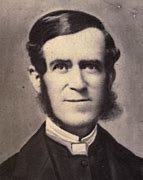
John Geddie
1815 – 1872

“The love of Christ banished the terrors of the law.” Those were the words of John Geddie concerning his salvation at age nineteen in 1834. He tirelessly preached this same message of Christ’s love as a missionary in the New Hebrides islands for twenty-four years.

John was an avid reader; his favorite subject being stories of mission efforts and the desperate need of the Gospel in unevangelized areas. After completing secondary school at Pictou Academy in Nova Scotia, he studied theology. Small and slightly built, he was often referred to as “little Johnnie.” While at seminary, his health became so poor that he was told to give up his studies. He promised the Lord that if his health were restored, he would go as a missionary to a heathen land. On March 13, 1838, he was ordained and began pastoring a church on Prince Edward Island.

During his time as pastor, he promoted foreign missions which was a new idea to the colonial churches. Up to this point, they had sought financial aid for their own work, but had not considered sending out missionaries. It took several years and many pleas, but a mission society was finally formed. John and his wife were the first missionary volunteers. Their destination was Aneiteum, an island in the New Hebrides where people practiced cannibalism.

The Geddies arrived in New Hebrides in 1848 and soon felt the reality of their situation. They were on an island, surrounded by people from whom they had much to fear and whose language and customs they did not know. Geddie wrote, “We have His promise, at whose command we have come hither, ‘Lo, I am with you alway.’”

Their first task was to learn the unwritten Aneiteumese language. Then they began to print materials and teach the people to read. After three years and much labor, John had won a total of ten people to the Lord. Several times, while walking the trails, spears and clubs were thrown at him. He once faced an angry crowd of men who threatened to kill him for interfering as they strangled a young widow to death that she might “join her husband in the afterlife.” He unwittingly violated some cultural taboos and made the chieftain angry. But eventually the message of Christ’s love penetrated the hearts of the people and hundreds turned to the Lord.

As people were saved and their lives changed, John began to teach them and send them out to other islands with the message of the Gospel. People came from all over the region to see what had happened in Aneiteum. One group even brought a pig in the hopes they might use it to purchase a teacher to take back to their village. When John Geddie died on December 14, l872, a tablet was placed behind the pulpit of the church in Anelcauhat which reads: In memory of John Geddie, D.D. When he landed in 1848, there were no Christians here, and when he left in 1872, there were no heathen.”

Spring 2022

The ground is level at the foot of the cross, meaning that all are welcomed and received equally when they come to God through faith in Jesus Christ. Jesus made a full and final atonement for the sins of Adam and all his descendants. Not only does God desire that all would arrive at the cross (1 Timothy 2:4), He commands it (Acts 17:30). The ground is indeed level at the foot of the cross, but the road leading there is not. For some there are seemingly insurmountable obstacles along the way.

To the place I heard the Gospel for the first time, I drove one mile on a paved road. I passed no checkpoints, and no armed guards asked where I was going. I walked into the building in broad daylight. It was not an underground church service. I feared no retaliation from a religious system. No family member opposed my going or persecuted me afterward. I heard the message in my language without it going through an interpreter. If I did not know better, I might think God loves me more than most people in the world. For me, the road to the cross was smooth and easy. I wish it were for everyone.

Most in the world know nothing about the cross or that there is even a road to it. No one gets to the cross without the message of the Gospel, and it simply has not been declared where they live. Contrary to God’s will, these poor souls live and die without the Gospel.

Another huge obstacle is social control, commonly called peer pressure. A society keeps its people in line with the threat of punishments. Punishment might be mild like gossip or ostracism or as serious as death. We have heard of a father killing his child that converted to Christianity. It is much easier to get to the cross from North Carolina than from North Korea! The fear of exile from a family or group is terrifying. A Muslim in Indonesia told a BBTI graduate, “I am an Indonesian, a Sunda Muslim. If I trust Christ, I am no longer a Sunda. If I am not a Sunda, I am nothing. I have no home, no family, no house, no relationship. I know I am a sinner, and I do not want to be punished for my sins. I know Jesus Christ is the Savior of the world, but I would rather risk suffering eternally in the lake of fire than to lose my social identity in this life.” (Missionaries in these difficult places are not going to see quick results; we need to be patient with them.)

To illustrate this difficult struggle against social control, consider the following from BBTI graduate Emanuel, who along with his wife, Courtney, works with Afghan refugees in Greece:

“Iman is not like the normal Hazara Afghans that are the majority here. In fact, there is a lot of fighting between Iman’s Panjshir group and them. Iman says they all convert easily because they don’t take their religion seriously. They will change again later from Jesus to something else when the situation affords. Iman on the other hand owns his faith. He has a very strong national pride that relates to his religion…But then here comes the dichotomy. For all this die-hard insistence, in the same conversation he will confess that he is tired of religion and wishes there were a way to connect with God directly without going through books, prophets, and go-betweens.

Over the weeks, we have had many conversations about the identity of Jesus. We showed him many scriptures, each of them shedding more light, but still, he would insist that he cannot accept that Jesus is God. We learned not to press the point. Instead, we befriended him, along with many others. We built trust, and he started coming and reading the Bible. When his younger brother was missing for days, we prayed with him. We let him talk about his life, his brothers who are fighting the Taliban, his mother whom he loves more than any other person, the three cows they have, the customs and values they live by, the climate of his mountain home, why he left it, the challenges along the way, and how he misses his family. For every hour we have spent teaching, we have spent as much listening. Slowly he was drawn in.

Now, he enjoys the Bible more and interacts with it better than most Christians I know. I can give him a passage, and he will read it and then preach it to me. He would make a great preacher. He loves Jesus… Still, he could not accept Christ’s identity. Until recently that is.
The other day we had a God-ordained hour with him, showing repeatedly that Jesus was in fact worshipped by men and angels, that he not only permitted it, but God commanded it, and that one day every tongue, including Iman’s, will confess that Jesus is Lord. At the end, he confessed that he believes it is true, but he has a family, which I suspicioned, for all his claims of independence, was the real reason he could not accept Jesus as the Son of God. If Jesus is right, his family, his nation, his heritage, has been mistaken for hundreds of years. That is an incredibly hard pill to swallow for one who is not bitter and hurt by his native culture, but proud of it…For such a person to become a follower of Jesus, what must he lose? Father, mother, brother, and sister, yes, Islam. He must find a new reference point, with new values, new beliefs, a new community, a new Lord and Master, a new Book, a new road, a new everything. Nothing old can stay the same. All that is dear to him must be eclipsed by One who beckons to him with nail scars in his hands and feet.”

It was easy for me to accept Jesus. I did not lose my family, my job, or my country. Not so for many. What will it take to get people like the Sunda Muslim or Iman down the road to the cross? Someone must obtain specialized training for the task. He must give up all he knows and loves and go to where they live, he must patiently learn new tongues and cultures, and he must not look for shortcuts or quick results. He must be willing to walk a difficult, dangerous road with the seeking sinner until they reach the level ground at the foot of the cross.

Spring 2022

We asked our language helper for the two statements: (1) That is a shovel. (2) That is not a shovel. I felt certain he didn’t understand my instructions because the two statements sounded identical. I challenged him by confidently saying, “You are saying the same thing.” What was I doing, correcting my language helper when I knew so very little about his language? I felt so foolish when I realized that though the two statements did have identical sounds, there was a difference in the stress placed on one of the syllables. —Charlie, Ghana


The missionary’s  audience was a little perplexed as he told them the disciples were all on a “rock” in the middle of the sea.  The audience wondered why the disciples were there and how they even got there. It was even more confusing when the missionary illustrated that Jesus Christ is our “boat” that never moves.  They were curious to know how the motionless boat represented Christ.  The message was clarified when the missionary realized he had confused the word “dunga” (boat) with “dhunga” (rock).  —Justin


In Nepali culture, as in many cultures around the world, children are often a conversation piece. You often hear compliments such as kasto ramro chhori! which means, “What a GOOD girl!” given to the parents. However, an untrained foreigner who attempts to reproduce this compliment could easily offend the other parent by saying, kasto ramro chori! which means, “What a good THIEF!” —Justin

We finished our first semester of Hebrew a few weeks ago. We are enjoying a break but are also looking forward to getting back to our studies. We now know enough Hebrew to be dangerous, and if we’re not careful, get into conversations past our understanding. The word for the phrase see you later is “lehitraot,” but I didn’t say it right. What I said was the word for pasta; it’s so easy to get some strange looks! —M.P.


Cliff and Mary Middlebrooks are sent from Redemption Baptist Church in Decatur, Alabama. cwm1611@gmail.com

by Cliff Middlebrooks

I had thought that missionaries were an extinct species who had all died off in the day of David Livingstone. But shortly after the Lord saved me, I met my first real, live missionary! Then, while serving a tour of service in Korea in the Air Force, I asked people in America for the names of missionaries that might be in my area. Every time I had leave, I took the bus as far as I could and then hiked back into the mountains of Seohae-Dong to help a missionary who operated an orphanage for the Deaf. After separating from the service, I laid a map out before the Lord and asked Him to send me to the Pacific Islands as a missionary. His answer was a resounding “no.”

My wife Mary and I busied ourselves in the work of the Lord. Over the last forty years we have served in many different capacities. We always sought to do what God led us to do as He led us to do it. Each time our ministry and focus changed and we asked the Lord, “What would you have us to do?” it was always preceded with, “May we go to the mission field now?” His answer was always “no.” However, we took young people on short term mission trips. As our son and several students that we had taught over the years surrendered their lives to the mission field, we resigned ourselves to the idea that perhaps the Lord felt a better use for us was to train others and send them off to serve on the foreign field.

After pastoring for a number of years, we found ourselves at the same ministry crossroad. This time, when we asked if we could go to the mission field our hearts began to be convinced that the answer was yes! (At first, we did not admit it to each other for fear the other would think we had lost our minds!) We needed confirmation that this was truly the will of the Lord and not our own desire. So, without saying much to anyone about why we were going, we went to Nicaragua seeking for answers. And God did answer!! He opened door after door and began to lay detail after detail in place for us. Some people have called us crazy for going to the mission field at our age when most people are thinking of retiring. We call it the greatest privilege of our Christian lives.

Winter 2021-22

The 10/40 window covers Africa and Asia between 10 and 40 degrees north of the equator. The world’s most unevangelized countries are located in this rectangular area. Because it includes the majority of the world’s Muslims, Hindus, and Buddhists, it has also been called the “Resistant Belt.”

Several BBTI graduates that we must not identify serve in countries of the 10/40 window. Missionaries are most needed where they are least welcome, and we rejoice that they are declaring the Gospel in places controlled by atheists or religious fanatics. Because many of these countries have laws against proselytizing or even distributing Christian literature, missionaries must operate under the radar. We must be especially careful not to expose them as missionaries; our carelessness with social media or the internet could cause them to be expelled from their country or worse.

Brother C—— and his wife S—— were recently expelled from a large Muslim country. They are working and praying for visas to return. In the meantime, they are conducting Bible studies with their people by Zoom.

T—— and his wife C—— live in the Middle East and are currently helping individuals who are escaping from the Taliban. They are helping these desperate souls with food and of course, a Gospel witness. Their young son does not want the Taliban to be killed because he does not want them to go to hell.

P—— and L—— have worked very hard learning the language in their Communist Asian country. He was able to preach and teach over twenty times this last year, and L—— has also taught several lessons. C—— and K—— have worked in the same country for many years. C—— is busy teaching in a secular university, preaching in secret church services, and helping with a Bible translation project.

J—— and K—— work in a different Communist Asian country. They too have learned a difficult, tonal language. They have endured a severe lockdown, but they get out to visit people as much as possible without getting into trouble with government officials.

R—— reports that she is making good progress learning her new language. Her country is not closed, but she plans to work on a Bible translation project for a large people group in a neighboring Muslim country that is very unfriendly toward Christians. This means that R—— will need to learn two languages. We are praying for others to join this project in the days to come.

K—— and his wife Y—— have been in the states taking care of necessary family business, but they should be back in their country by now. Brother K—— is working hard to learn the language while Y—— already speaks it well. Their country is not closed to missionaries, but they hope to reach another nearby country that is very closed.

J—— and N—— desire to return to their field. They thought they had all the necessary paperwork together only to learn that the rules had changed, and they needed to show proof of the COVID vaccine along with their visa application. The next possible date to submit their visa request is in January.

C—— and B—— want to return to their Communist country in Southeast Asia to continue their language learning. Pray their new visas will be issued soon.

It seems to be the COVID restrictions that are hindering J—— and T—— from returning to their ministry. God has been using them there in a very special way, and the enemy does not like it!

S—— and M—— are doing unusually well raising their support, but the Communist country where they originally planned to work is completely closed. So instead, they are looking at Thailand. We will keep them unnamed because they might go to the Communist country in the future.

Winter 2021-22

The 2000 census lists 45,000 ethnic Phunoi living in north-central Laos. Phunoi is one of eighty-four languages spoken in Laos. It is a Tibeto-Burman language which reflects the Burmese rule in Phunoi history. Phunoi is classified as a Loloish language which reflects a Chinese origin.

Experts believe there are 240 ethnic groups in Laos. In 1981, they were officially divided into five groups according to language. However, the former three group system is still commonly used, and it divides according to geographic location: lowland, hillside, and mountaintop. The Phunoi belong to the mountaintop group. The mountain forests furnish animals for hunting and food for gathering. Rice and corn are grown by the slash-and-burn method.

The official name of the Phunoi changed to Sinsali in the 1990s. The literal meaning of phunoi is “little people,” and Laotians now use this word in a disparaging manner. All tribal people are considered a low class of society and are referred to as phunoi.

Though many Phunoi have embraced Buddhism, the majority practice ethnoreligion. Ethnoreligion combines animism and ancestor worship. The spirits of animism are placated for favor in growing food or restoring health. The spirits of ancestors are invoked for protection and guidance. There is no Phunoi Bible to tell this people the story of the one true Creator God.

Allen Gardiner paced up and down the street, ashamed to go into the bookshop and ask for a Bible. He had thrown aside his religious upbringing at the young age of fourteen for the rowdy life of a sailor, but now he needed answers. The letter that arrived, telling of his godly mother’s prayer for him before her death, struck his heart with a desire to read the Book that he knew held life’s answers. Secreted with the newly purchased volume in the quiet of a Chinese temple, Allen Gardiner came to faith in Jesus Christ.

With an earnest drive for missionary work, Gardiner went to South Africa in 1834 to win the Zulus to Christ. Although they were notorious for savagery, he brought about peace between the warring tribespeople and opened the door for missions among them. When war broke out between the Dutch settlers and the Zulus, it became impossible to continue the work, and he set his face toward South America.

As he traveled through the continent of South America, seeking to work with the native tribes, he was repeatedly thwarted by governmental regulations, Jesuits, or lack of funding. He also sought to go to New Guinea but was told, “You might as well try to instruct the monkey as the natives of Papua…they’ll never be any different.” Gardiner retorted, “They are men, not animals, and they are included in our Saviour’s command to preach the Gospel to every human being.” Though access was denied him, he did not give up.

He turned to Tierra del Fuego, knowing there was no government or religious system to deny his entry. Two previous attempts to land there had taught him that the Fuegians were violent and thieving. His team, totaling seven men, arrived in December of 1850. The mission began to fail the moment it started. Part of their supplies were left on the ship that landed them, and most of the rest was stolen by the Fuegians who also drove them from the coastline. The men took refuge in a nearby area but were unable to find enough food to survive. One by one, they starved to death. The scheduled supply ship returned twenty days after the last entry in Allen Gardiner’s journal.

Their death created worldwide headlines. Most condemned their “folly and failure” in the venture, but it stirred the heart of the church. A new mission team was sent and, after much turmoil, succeeded in winning many of the Fuegians to Christ.

Twenty years earlier, Charles Darwin had stated that it was “completely useless to send missionaries to savages such as the Fuegians, probably the lowest example of human race.” Darwin later saw for himself the difference the Gospel had made. He was astonished at a people so changed physically, mentally, and spiritually that he not only stated his belief in the regeneration of the people but contributed to the South American Missionary Society during the rest of his life.

Winter 2021-22


Understanding of a people’s culture is vital. If the missionary does not know the culture, he is likely to deliver a confused message. The following article by a BBTI graduate, whose identity we must conceal, demonstrates this fact. Understanding of a people’s culture is vital. If the missionary does not know the culture, he is likely to deliver a confused message.

In the process of language learning, we have heard several folktales and children’s stories and have learned much about the people’s cultural mindset and worldview. We have seen at least three common themes.

Firstly, people are collectivists, NOT individualists. In America, we have been rooted in humanism to the point that “I define me.” In other words, I get to decide what I think is right and wrong. In general, westerners want to stand out of the crowd, be their own person, and have their own opinions. It does not work that way here. A person’s goal in a collectivist society is to progress the community; all are equal, and everyone is happy. Nobody has more than anyone else, we are all one big family, and what is mine is yours. This could explain why communism, to a certain point, makes sense here culturally. It is when the people discover that the dictators are above everyone else, have more, and are bossing people around that things begin to change. Which brings us to the next point…

Authority (without reason) is almost always resisted and rebelled against. If others (the pu-nyai) are over you, they are expected to show respect and understanding to you and everyone else (the pu-noi) under them. This means that if you give a rule, you should also explain why that rule is being enforced. Giving a reason shows you care about others and are helping to further everyone so that all live in unity. Otherwise, you are just a jerk full of pride scolding the underlings.

Last of all, deception is considered heroic. A typical hero in a folktale is an underling (pu-noi) who deceives the dictator/jerk (pu-nyai) in order to shame him, make him “lose face” in the community, and bring down his pride. We have seen this pattern over and over in these stories. A clever trick played on someone, usually in a humorous way, shows not only how the trickster does not like the jerk, but that he thinks the jerk is something he should not be. It is a way to “get the upper hand” so to speak. Here is an example of a story involving these things:

“Please don’t put me in the bucket!” called a soft voice.
“Oi! The fish can talk!” the lady said with a startle.
“Please don’t put me in the bucket!” the little fish begged again.
“But if I don’t catch you, I will not have anything to eat!”
the lady replied.
“But I am so young and very small,” implored the fish. “You will not have enough to eat. Why don’t you put me back in the water and wait until I am fully grown? Then you can catch me again, and you will have more to eat for that meal.”
After some thought, the lady conceded. She gently placed the little fish back into the river.
The little fish, happy to be free again, swam and splashed as far away from the net as he could, determined to
never return to that spot in the river.

Here we observe the pu-nyai, the lady who will catch and eat the fish (which only benefits her and leaves no mercy for the fish). The pu-noi, the little fish, resists and outsmarts her, even lying to her that he will be there again for her to catch once he is grown up. His trickery saves the day, he swims free (a small victory for all fish everywhere), and the woman is assumed to go hungry that day.

How does this affect the missionary? Take, for instance, the story of Adam and Eve. At first, if you hear the story through our people’s ears, God could
be considered a bad pu-nyai, giving rules without reason; the hero of the story would be the serpent, Satan. In deceiving Eve (by mixing truth with lies), he really deceived God and foiled His plans. And now all the earth and humankind are as corrupt (thus on the same level) as Satan. Imagine trying to convey the Gospel when Satan is seen as the hero!

However, if we show that God is a good pu-nyai, giving reasons for his rules (“In the day that thou eatest thereof thou shalt surely die.”), thus trying to look out for and protect the pu-noi under Him, we see that deceiving Him is the worst blasphemy ever! Now, the deceiver is harming the one that protects the community, making himself the pu-nyai who is getting something only for himself and hurting everyone else. It shifts the situation entirely.

Now consider Christ Jesus. He was and is THE Pu-Nyai: Creator God, holy, sovereign, all-powerful, eternal, worthy of all praise. He stooped down and became a humble Pu-Noi. He had no more than anyone else around Him; He roamed homeless, often only finding solace on the Mount of Olives. He helped make the lives and souls better for those around Him. He had compassion on His fellow men. He did not come as Pu-Nyai, even though He is worthy to make the rules. He came as one of us, so He could be accepted by us.

As missionaries, we MUST be learners before we can be teachers, or we will find ourselves having to correct grave errors in our teaching. We cannot just spread the Gospel without giving due attention to culture. The way we pre- sent things may or may not make sense to the hearers. We must be pu-noi, just humans among fellow humans, serving our Heavenly Father, the Pu-Nyai of pu-nyai, the holiest and worthiest of all.

Rex Ray 1885-1958

“I looked my guard over. He wore two belts of cartridges, a dirk knife and carried a rifle with a bayonet . . . I prayed, ‘Lord, you can handle him better than I can. You just put the fear of God in him and make him leave me here alone.’ Then I began staring at the guard as though I might eat him if he got too close. He began to get nervous; he twisted his hands and walked to and fro. In a few minutes, he started off. When he was about fifty yards away, he raised his rifle and cocked the hammer. I was looking at the shooting end. I could only pray, ‘Lord, if you don’t want him to kill me, just don’t let him pull that trigger.’ The Lord answered, for the bandit started off down the trail.”1

Born in north central Texas in 1885, the eldest son of a ranching family, Rex Ray learned early to work hard, to persevere regardless of his circumstances, and to hold to his responsibilities “come wind, come weather.” His father unexpectedly died at a young age, and Rex, at only fifteen years old, took over the responsibility of caring for his mother and younger siblings. Rex resisted the Gospel message as a teenager and entered college at the age of twenty intending to be a successful businessman. God had other ideas. Rex was saved during a revival meeting in a Baptist church. Later, after spending a week going to the cornfields every night to pray, he answered God’s call to the mission field.

Rex and his wife, Janet, served the Lord in China through the waves of turbulent attacks by the Japanese during the Second Sino-Japanese War (1937-1945) and takeover of communism in 1949. During that time, not only was Rex kidnapped by bandits, but he also ran blockades to provide supplies to the mission hospital and survived air raids and bombings. He buried his five-year-old daughter on the field. Through it all, he preached. Up and down the rivers and through the villages, thousands of precious souls heard the Gospel of Christ as he desperately gave the message of Christ while the doors were still open to do so.

When the doors to China slammed closed, Rex and Janet (their children now grown) answered the call to take the Gospel to war-torn Korea.

This only scratches the surface of what happened during Rex Ray’s forty-eight years on the mission field. His passion for the Gospel and his love for the Chinese and Korean people speak from every page of his autobiography.

In a letter to the Foreign Mission Board, published in the September 1928 Home and Foreign Fields, Rex Ray said, “Oh, that our voices could be multiplied into thousands to help rescue these millions who are lost, lost, lost! The Spirit of God is moving the hearts of the heathen. Oh, that He would awaken His children in Christian lands to the crying needs of this great harvest field! If Christian America fails to deliver God’s message to the lost of earth, what shall we answer the Master as these poor souls turn away from the gates of Glory into outer darkness?”

1Cowboy Missionary in Kwangsi, Rex Ray


Located in the heart of the second largest island of the Philippines is a tribal people who cling tenaciously to their ancient customs and traditions. The Bagobos are a people steeped in ethnoreligion. They combine spirit worship, ancestral worship, and nature worship into a religion that is strict in ritual and full of fear. They are fiercely territorial, suspicious of outsiders, and very resistant to the efforts to assimilate them into the other cultures and languages around them. They believe to do so is to deny their religion and entire way of life.

The Bagobo are one of the largest groups of indigenous people of southern Mindanao. Historically a warring tribe, the Bagobos raided neighboring villages and offered human sacrifice to their deity, Pamulak Manobo, until the practice was forbidden under Spanish rule. They are largely agricultural, and rice is the staple of their diet. This diet is supplemented with hunting and fishing. The planting, cultivating, and harvesting of rice is deeply tied to religious rituals. Planting coordinates with the movement of the stars, hoping for the good-will of their god of the growing season. During harvest, the leader of their tribe (the Datu) will give an offering to the “spirit of the harvest.”

The Bagobo speak their own distinct dialect. It is an unwritten language with no Scriptures, therefore the
80,000-100,000 Bagobo souls are without God’s message.

This title comes from an article by Paul Fleming. It makes us laugh but should make us cry. In practice, a lot of men are saying, “Send my sister.” Fleming goes on to write:

We men! We are the stronger sex; it has always been so! We send our gifts to mission fields, to which the women go. While up the steepest jungle paths, a woman bravely treads, We men, who are the stronger sex, do pray beside our beds. When women leave to go abroad, the heathen souls to reach, We men, who are the stronger sex, do stay at home to preach. While women, in some far-off shack, do brave the flies and heat, We men, who are the stronger sex, in cool and comfort eat. Fatigued and weary, needing rest, the women battle on. We men, who are the stronger sex, do write to cheer them on! O valiant men! Come let us sleep and rest our weary heads. We shall not be the stronger sex if we neglect our beds!

We do not deny the important role that women play in God’s work. Women from Galilee followed and ministered to Jesus and his disciples. Paul named several faithful women who served in the early churches. Over the centuries, thousands of women, both single and married, have left their homes to work in heathen lands. Some, no doubt, preached a little more than we think they should have, but probably because no man was there to proclaim the Gospel. Whether on the foreign field or at home in our churches, women are often the spiritual leaders because men have abdicated the position. Many times, women have a heart for God and a compassion for others that is lacking in men. This naturally attracts them to the mission field.

Women oftentimes have a desire to serve the Lord full-time just like men. At home, their full-time opportunities may be limited to church secretary or Christian school teacher, but on the foreign field, they can serve as missionaries. Missionary women understand what they should and should not do. They should work under the leadership of a male missionary or national pastor. They should teach ladies and children but not men. They may teach men to read and write or to speak English but may not teach Bible doctrine. They should not attempt to work in dangerous places where they risk being violated. Of course, single men have limitations on the foreign field as well. A well-prepared Aquila and Priscilla team is perfect.

Over the last twenty-one years at BBTI, the single female students have outnumbered the single male students by two to one. Some single graduates get involved in short-term missionary work, but as a rule, if they remain unmarried, they will not be career missionaries, especially the single men. Unmarried ladies are much more likely to go to the field as full-time missionaries than single men.

The great need is for men, single or married, who will go to the foreign field and stay. Thank God for the ladies who have this desire, but where are the men? Why are they avoiding missionary service? Could it be that they are not being confronted and challenged? Spurgeon said, “Not all men should be missionaries, but all men should struggle with it.” Pastor, make the men struggle with it. When they say, “I’m not called,” pressure them to tell you how they came to that conclusion. How much did they pray about it and study God’s Word on the subject? How did God reveal to them that they are called to stay? Do not let them off the hook so easily. Most of our churches are not producing missionaries; we should find out why! We support missionaries, but are we producing them?

Military experts tell us that seventy-five percent of our military age men are unfit for service: 25% lack a high school education, 30% are too ignorant to pass the entrance exam, 10% are disqualified due to criminal convictions, 27% are obese, and 32% of the age group have other disqualifying health problems. And since we have an all-volunteer military, a man can simply not volunteer. The same is true in God’s army. God may impress a man that he should go to the mission field, but that man has a will and can refuse; men do it all the time!
Disqualifying factors for missionaries are different, but they are numerous: LifeWay Research reports that 66% of young people drop out of church after high school. Others are addicted to pornography, video games, social media, texting, pleasure, money, and tattoo ink. Most want to simply be comfortable and live the good life. For those who are even somewhat interested in missions, there are many pitfalls and detours that lead anywhere but to the mission field. We as a church must protect potential missionaries from the wiles of Satan. We must nurture and encourage them by keeping the mission challenge before them.

Nothing short of real revival is going to produce male missionaries. We must fall in love with our Lord Jesus Christ and get interested in what is on his heart. He said, “And why call ye me, Lord, Lord, and do not the things which I say?” (Luke 6:46). He said to preach the Gospel to every creature; yet billions have never heard a clear Gospel message. He said, “If ye love me, keep my commandments” (John 14:15). His commandment to go and teach all nations is ignored; there are still thousands of unreached nations (people groups). He said, “Ye are my friends, if ye do whatsoever I command you” (John 15:14). We are unfriendly toward Jesus because we are not evangelizing the world as He commanded.

Yes, we need a real revival, one that would result in men saying, “Here am I, send me” instead of saying, “Here’s my sister, Lord, send her.”

Photo Source: Shadegan – Wikimedia Licensed under CC BY-SA 4.0

An estimated four to five million Luri people live in the Zagros Mountains in the southwestern provinces of Iran.  Making up about 7% of Iran’s population, these ancient nomads are believed to be indigenous to the area, descended from ancient Persians. History reports that Luri ancestors were the Elamites and Kassites, dating back to 3000 B.C.  It was the Kassite dynasty that defeated ancient Babylonia and dominated Mesopotamia for 576 years.  Could this be the fall of the Babylonian empire under Nebuchadnezzar?

The Luri are divided into Northern and Southern provinces with southern tribes speaking “Laki,” a form of Kurdish, and northern tribes speaking “Luri,”  the closest living language to Old Persian. Neither language has the Bible. Men are often bilingual; while the women, restricted to their tribal lands, often speak only their tribal language. The literacy rate is very low with only 48% of the Luri reading and writing.

The Luri profess Shia Muslim, but practice very individualistic and diverse forms of Islam, including the mystic Iranian religion of Yaresan.  It teaches that man, aware of the outer world but ruled by the inner world, goes through as many as 1,001 reincarnations while his soul seeks perfection.  A famous Yarsani saying is “Men! Do not fear the punishment of death! The death of man is like the dive which the duck makes.” They need to know that an unsaved man or woman dives into hell.  And they need to know the One who can take them to heaven.

Fall 2016


Luri of Iran

Photo Source: Shadegan – Wikimedia Licensed under CC BY-SA 4.0

An estimated four to five million Luri people live in the Zagros Mountains in the southwestern provinces of Iran.  Making up about 7% of Iran’s population, these ancient nomads are believed to be indigenous to the area, descended from ancient Persians. History reports that Luri ancestors were the Elamites and Kassites, dating back to 3000 B.C.  It was the Kassite dynasty that defeated ancient Babylonia and dominated Mesopotamia for 576 years.  Could this be the fall of the Babylonian empire under Nebuchadnezzar?

The Luri are divided into Northern and Southern provinces with southern tribes speaking “Laki,” a form of Kurdish, and northern tribes speaking “Luri,”  the closest living language to Old Persian. Neither language has the Bible. Men are often bilingual; while the women, restricted to their tribal lands, often speak only their tribal language. The literacy rate is very low with only 48% of the Luri reading and writing.

The Luri profess Shia Muslim, but practice very individualistic and diverse forms of Islam, including the mystic Iranian religion of Yaresan.  It teaches that man, aware of the outer world but ruled by the inner world, goes through as many as 1,001 reincarnations while his soul seeks perfection.  A famous Yarsani saying is “Men! Do not fear the punishment of death! The death of man is like the dive which the duck makes.” They need to know that an unsaved man or woman dives into hell.  And they need to know the One who can take them to heaven.

Fall 2016


Uncontacted Tribes of the Amazon Basin

The Amazon Basin contains the largest tropical rainforest in the world, covering an area almost the size of the continental United States. Most of the basin lies within Brazil, but it also encompasses parts of Bolivia, Colombia, Ecuador, Guyana, Peru, and Venezuela. It is home to an estimated twenty-six million people, including isolated and even uncontacted tribes. Some have denied the existence of as yet uncontacted tribes, but it has been documented by eye witness reports and by aerial video footage.

These uncontacted tribes are resistant and hostile to anyone approaching them. They and their land are currently threatened by mining companies, oil companies, and armed illegal loggers. Any contact with outsiders poses a threat of introducing a disease that can easily wipe out half the tribe; even the common cold is a real danger. For these reasons, the Brazilian government protects indigenous people and their land from intrusion.

How can these people for whom Christ died be reached with God’s message? And if a way to get to them is found, how can the spread of disease be prevented? Will we give it up as impossible? Or will we ask the God with whom all things are possible to make a way?

Summer 2016

Banjar of Indonesia

Photo Source: Marwan Mohamad – Wikimedia Licensed under CC BY-SA 4.0

The 4,127,124 Banjar, Indonesia’s tenth largest ethnic group, makes up 1.7% of the nation’s total population. They live mainly in Southern Kalimantan. There are also over a million Banjar in Malaysia.

The Banjarese language reflects the influence of the Dayaks, the Javanese, and the Malay peoples from whom the Banjar descended. This is a very active language; many of its speakers lack fluency in Indonesian. The script is Arabic.

This people has been dominated by Buddhist, Hindu, and Islamic kingdoms in turn. They have retained Islam which dominates their lives; 99.9% are Muslim. However, some Buddhist and Hindu beliefs and customs still exist.

Though friendly, the Banjar withdraw from others, preferring isolation to anything modern. They live in stilt houses along the rivers and coast. The rice grown in the tidal swamp is a staple. The fish, fruit, and vegetables sold by women from their small boats are also important to their diet. Rubber and pepper are export crops.

There are no Banjar scriptures, and no known missionary activity among them. Pray for God to raise up laborers.

Spring 2016


Eton of Cameroon

The official languages of the Republic of Cameroon are French and English. There are also 286 indigenous languages, one of which is Eton with an estimated 127,000 speakers. The Eton people live in the tropical rain forest of the Centre Region. They are subsistence farmers, using the slash and burn method to plant root crops (such as cassava, yam, and macabo), plantain, and groundnuts. Fishing and hunting supplement their diet. Cacao is a cash crop.

Although 74% of the Eton population is considered Christian, only 4% of that number is evangelical. The other 26% practice ethnic religions which are strongly tied to their cultural traditions. There are some local Cameroon  tribes who claim a Jewish background. Serge Etele, the Eton man pictured on the right, recalls from his childhood that circumcision was practiced and that they did not eat the animals which are forbidden in the Bible.

Children are growing up speaking Eton, but no scripture has been translated for them. Will you ask God to raise up laborers for that endeavor? A grammar of Eton, published by linguist Mark L. O. Van de Velde in 2008, would be of enormous value to anyone willing to undertake this critical task.

Winter 2015-16


The Deaf of the World

Every country in the world has a Deaf population, and they are largely unreached. Many of them have their own culture and a sign language distinct for that country.  Some deaf people live in isolation and loneliness, while others move to cities and form deaf communities.

There are actually two Englands— two English languages and two English cultures that co-exist side by side—the hearing and the Deaf.  Similarly, there are two Germanies, two Frances, two Spains, two Chinas, two Indias, and two Russias.  We are somewhat mindful to go and  reach the first language and culture. But do we ever think about reaching the other, the Deaf? The fact is that they NEVER even cross our minds.

Missionaries to the Deaf must be sent to reach this hidden world that most of us have forgotten. Otherwise, we can only claim to reach the nationals of a country. It is impossible for the Deaf to come to us, to become bilingual and bicultural. It is we who are commanded to go to them.

Summer 2015


Svan, Republic of Georgia

Isolated and sheltered from the rest of the world by the high peaks of the Caucasus Mountains, the Svan people have preserved and carried on their ancient culture for centuries. Eastern Orthodoxy arrived around the sixth century, yet, it quickly meshed together with primal customs such as sun worship, blood feuds, and animal sacrifices. This syncretized culture still runs deep among the people.

Because life became increasingly easier beyond the mountains, and deadly avalanches killed many in the late 1980s, many Svan have moved from their ancient homes and villages to the low lands of Georgia. Yet, they still hold to their deeply rooted heritage. Many return yearly to their villages for feast days and family rituals. Their unique music is experiencing a revival, though their unwritten language is dying. Those who remain in the mountains retain their old ways of living, their spiritual traditions, and their language.

The Svan look to a future of increasing notoriety, tourism, and progress; yet, a future of gospel witness looks dim. Will you pray that God will send laborers to this people?

Winter 2014-15

Yemeni Arab of Yemen

Photo Source: Rod Waddington – Flickr Licensed under CC BY-SA 2.0

There are an estimated 6,934,000 Yemeni Arabs living in the world today.  These tribal people are scattered throughout 16 different countries, but the majority of them live in Yemen.

Within their social structure are four classes of people: the wealthy, the tribesmen, the merchants and craftsmen, and the slaves.  These classes are very predominant and can be distinguished by the types of clothing worn.

This people group lives in fortress-like villages and elaborately decorated flat-roofed houses.  Social life is very important to Arabs, and they share a daily coffee time by sitting on the floor and drinking from cups without handles.  Their diet consists of wheat bread and porridge made with boiled meat or chicken.

Almost all of the Yemeni Arabs are Muslims and are quite fanatical in practice. There are less than 5,000 known believers in Yemen and no Bible in their language.  Who will reach these precious souls with the Gospel?

You can hear the Yemeni Arab language, Ta’izzi-Adeni, online at:  globalrecordings.net/en/language/6429

Fall 2014


Baka of Congo, Africa

For centuries, the Pygmies have been recognized as the oldest inhabitants of the African rainforest.  Throughout the forests of Cameroon, Gabon, and Congo, there lives a group of Pygmies known as the Baka.  Because they are so remote and widespread, there has been no accurate count of their population.

They are the people of the forest, with a vast knowledge of its animals and plants along with its natural medicines and cures. The women build their traditional, dome-shaped forest huts with branches and leaves. Newer, more solid homes are rectangular with mud walls. Baka family ties are very strong, and traditions and history are passed down from one generation to another by word of mouth.

Since the early 1800’s, these people have been claimed to be Catholic, but to this day they practice their traditional animist religions. They have no Scripture in their unwritten language.

Summer 2014


Aimaq, Char of Afghanistan

Photo Source: Tomas Balkus – Flickr Licensed under CC BY 2.0

The Aimaq Char of Afghanistan is a people group comprised of four different tribes: Taimani, Firozkohi, Timuri, and Jamshidi. It is estimated that 250 subtribes exist within these. The population of this group is 334,000 and 148,000 of them live in Afghanistan. Their primary language is Aimaq, but Farsi is spoken in the schools.

Foods commonly eaten are thick wheat bread, chickpeas, rice, potatoes, and other garden vegetables. Chicken, eggs, or lamb are often eaten at festivals. The women dress in bright, vibrant colors, but outside their homes they wear dark head-to-toe coverings. Men wear turbans along with a type of cloak that hangs from the shoulders.  The people measure  wealth by the amount of animals owned.

This people group does not have a Bible in their language. By law they are forced to profess and practice Sunni Islam. Because they trace their lineage back to Abraham, many of the Old Testament stories are somewhat known to the people. However, there is no missionary work nor outreach to this group of people. God is calling. Who will go?

Spring 2014


Miao of China

The Miao are one of the 55 officially recognized minorities in China. With a population of 9.6 million in China alone, they form the country’s fifth largest ethnic minority. Because of past oppression and multiple migrations, they are scattered across several provinces in Southeast China, and many Hmong (a Miao sub-group) have settled in Southeast Asian and Western countries.

The language family of the Miao includes 35-plus languages, only three of which have Bibles. Most of the Miao languages are unwritten; but they are widely spoken, living languages. Mandarin Chinese is taught in the schools, but many Miao do not have an education past elementary school.

The Miao are a gentle, friendly, and peaceable people— known for their love of music and for their bright, ornate clothes. They have an honest, trusting nature and have historically lost wars due to lack of strategy.

Most Miao practice animism and live in fear of evil spirits. However, when the Big Flowery Miao (a Miao sub-group) were given an alphabet and the New Testament in their language in the early 1900’s, thousands came to Christ. But what of the many other Miao languages still without the Word of God? Who will take it to them?

Winter 2013-14